No. The scanner alerts your staff. Whether police are called is up to your business policy and local law.
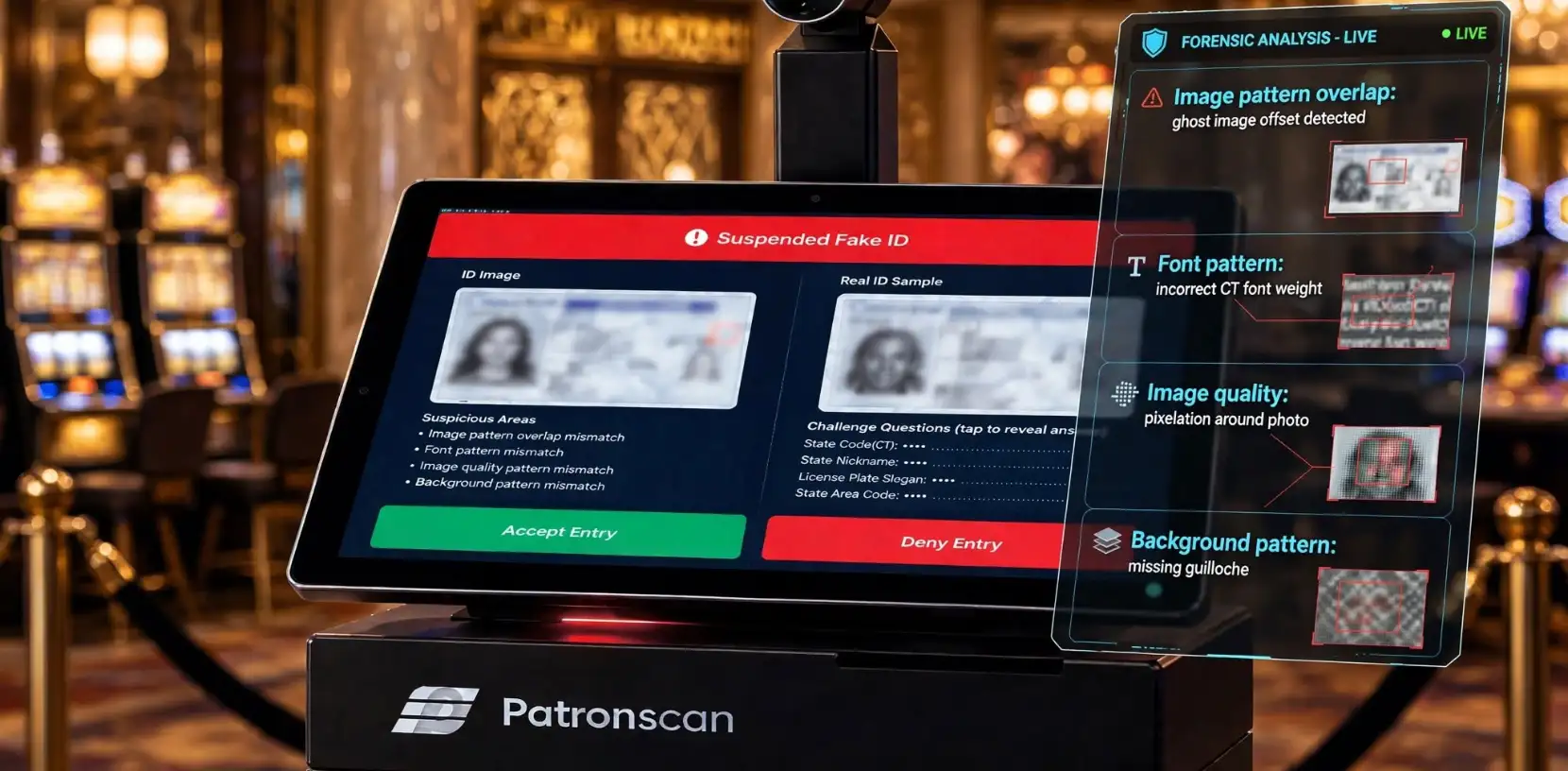
When a scanner flags a counterfeit ID, it fails in seconds and staff see an alert that explains what’s wrong with the document. From there, it’s a person’s decision: refuse entry or service, follow your business’s policy and local law on keeping the card or calling police, and let the system record what happened.
This guide explains how the technology works, what staff should do next, what the law says, and how Patronscan handles an alert.
How ID Scanners Catch Fake IDs
Cheaper ID production equipment means a modern fake can look and feel real, and many scannable fake IDs pass a basic reader. Even an advanced barcode reader only confirms that the data is formatted correctly. That’s why fake IDs that scan and pass at traditional scanners are such a problem.
| Scanner type | What it looks at | What it misses |
| Smartphone app (iOS or Android) | The PDF417 barcode on the back | Counterfeits with a matching barcode |
| Basic barcode reader | Barcode scans and date of birth | A sophisticated fake with copied data |
| Forensic ID scanner (countertop or handheld ID card scanner) | The whole card under white, UV and IR light | Very little; pair it with a photo comparison |
Reading a barcode is a quick form of fake ID check, but it isn’t full identity verification. Forensic ID authentication proves that the card itself is genuine.
How a Fake ID Scanner Checks an ID, Step by Step
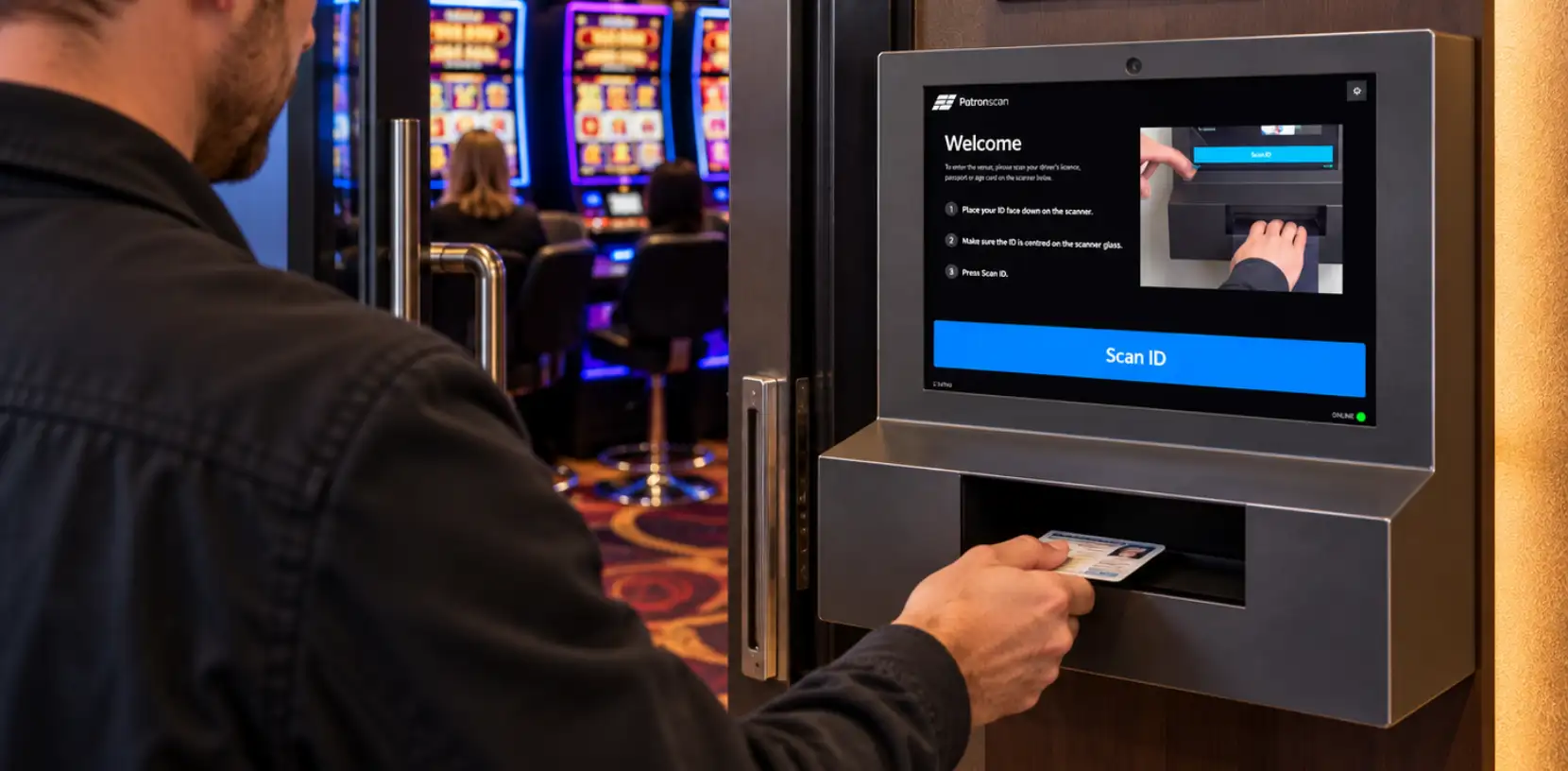
A forensic scanner reads far more than the barcode. Here’s what happens from the moment the card goes in:
- The card is imaged. The scanner captures the front and back under white, UV and infrared light, revealing invisible security features.
- The design is identified. The system recognizes the official state or country format, such as a state-issued card or a passport, and compares it with a template built from real IDs of that exact version.
- Forensic tests run. Patronscan’s system analyzes 8,500+ data points, including micro-security features, embedded security elements, UV and infrared patterns, and barcode integrity (Patronscan).
- The front is matched to the data. Optical character recognition (OCR) captures the printed text on the front, including the name, date of birth and ID number. It’s matched against the barcode’s digital structure and formatting rules, and any inconsistency is flagged.
- A verdict appears. The fake ID checker decides whether the ID is real or fake, expired or underage, usually in under a second for a simple scan and within 10 seconds for an advanced ID authentication scan.
When the card fails, the screen tells staff why: a barcode that doesn’t match the front, missing security features, or a layout that doesn’t match any genuine design.
| Alert type | What it usually means |
| Counterfeit or suspicious | The card failed one or more forensic checks |
| Expired | Genuine, but past its expiration date |
| Underage | Genuine, but the holder is under the legal age |
| Flagged person | The ID may be genuine, but the holder was flagged for past behavior |
What Your Business Should Do When the Scanner Flags an ID
The system gives staff the facts. A clear, calm process turns that into the right outcome:
- Stay calm and keep it private. Don’t accuse anyone in front of the line; say the ID couldn’t be verified.
- Read the reason on screen. An expired card or an unusual out-of-state ID is different from a clear counterfeit.
- Do a quick manual review. Compare the photo to the person and ask simple questions, such as their zip code or birth year.
- Ask for a second ID if your policy allows it. A legitimate customer can often produce one.
- Refuse entry or service. If the ID can’t be verified, don’t admit or serve the person.
- Follow your policy on keeping the card. Only keep it if your state allows it and follow the rules exactly.
- Escalate if needed. Call a manager, or police if the person becomes aggressive, or your policy requires it.
- Let the record stand. The scan, the alert and the time are logged automatically; add a short note.
Your business should never let staff use force to take a card or rely on an alert alone when something doesn’t add up. Technology is a tool; a trained person makes the final call.
What the Law Says When You Catch Fake IDs
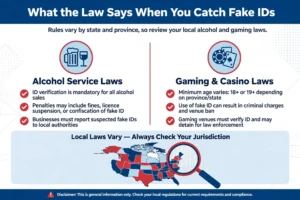
Rules vary by state and province, so review your local alcohol and gaming laws.
For the person using a fake ID
Possessing or using a fake state ID can be a misdemeanor or a felony. Penalties can include fines, jail, community service, probation and suspension of the person’s own driver license (FindLaw).
Can a business keep a fake ID?
Sometimes. Under Iowa Code 123.48, a licensee who reasonably believes an ID is altered, false or belongs to someone else may keep it, but must:
- Give the person a receipt showing the date and time
- Deliver the card to local police within 24 hours
- Include a written report of what happened
Licensees who follow those rules are protected from criminal and civil liability, except for unreasonable force. Elsewhere, staff should refuse service and hand the card back, or call police.
Why scan records support compliance
In California, a licensee can defend a sale-to-minor charge only if staff demanded, inspected and reasonably relied on a government-issued ID (California ABC Appeals Board). A timestamped scan record proves that diligence and supports compliance with liquor laws.
This section is general information, not legal advice.
How Patronscan Checks Fake IDs with Forensic ID Scanning
Patronscan’s ID verification scanner adds additional verification layers, so a fake ID alert leads to a clear action, not just a red screen:
| What happens | Why it matters |
| A real-time verdict on authenticity: authentic, expired or suspicious | Staff know right away whether to admit, refuse or look closer |
| An SMS alert to your team | Managers and security know about a suspicious card or flagged person as it happens |
| An encrypted, timestamped record of every scan | Evidence for licensing boards, insurers or police if questions come up later |
| Optional flagging of the person | Someone who tried a counterfeit at one location is flagged at every location in your network |
| ID designs updated weekly | New and redesigned IDs are recognized quickly |
Patronscan checks 8,500+ data points across 14,000+ ID types, and its cloud platform keeps every record ready for review. It works at the door with the Guard+, which connects over WiFi or Ethernet, anywhere on the floor with the Handheld, or at unmanned entrances with IVAC access control, which keeps the door locked when an ID fails.
Whether you need an ID scanner for clubs and bars, a casino, a liquor store or a car dealership, the same validation applies at every venue and location, and a retailer can use it at the returns desk to stop ID fraud. People who believe they were flagged in error can dispute it through Patronscan’s flag dispute process.
To see what your staff would see when a fake ID is scanned, book a Patronscan demo.
FAQ: What an ID Scanner Reads and How to Check Fake IDs
Can the scanner be wrong?
Good verification software can still flag a genuine but unusual card, such as a brand-new design or a damaged ID. Staff should read the reason on screen and do a quick manual review before refusing someone.
Can my staff keep a fake ID?
Only where state law allows it, and only by following its rules, such as giving a receipt and handing the card to police within a set time.
What happens to the person who used a counterfeit ID?
They’re refused entry or service. Depending on the state and your policy, they may also be reported to police and face fines, a suspended driver’s license or criminal charges.
Will they be flagged at other locations?
With Patronscan, yes, if your team flags them on the public network. The flag applies across every location in your network.
Can a fake ID that scans still get caught?
Yes. A forensic scanner checks the whole card, not just the barcode, so a scannable fake can still fail.
Featured Resources