Many fake IDs can pass a basic ID scanner, but advanced forensic scanners like Patronscan catch up to 90% of fakes. Scanners that only read the barcode or magnetic stripe check whether the data is formatted correctly, not whether the ID is real. Because barcode formats are publicly documented, well-made fakes can be encoded to scan as valid. Forensic scanners close that gap by analyzing the entire ID, including fonts, imagery, and security features under multiple light sources.
Key points:
- A barcode check confirms the data is readable, not that the ID is real.
- Pattern matching is the single most effective automated test for spotting fakes.
- Hologram and UV tests help, but high-end fakes copy these features too.
- A scanner is only as good as its engine and how often its ID library is updated.
Fake IDs get caught by scanners that go further. These scanners compare the front of the ID against an authentic template pixel by pixel (pattern matching), test holograms and UV features under controlled light, and run everything through a scanning engine trained on millions of real scans.
Why Barcode Scans Don’t Stop Fake IDs
A barcode or magnetic stripe scan checks whether an ID’s data is in the correct format. It doesn’t check whether the ID is authentic. These features exist so scanners can pull a name, date of birth and ID number quickly. They were never designed as strong security features.
That makes them easy to fake:
- The encoding standards for ID barcodes are publicly documented.
- The tools to print barcodes and encode magnetic stripes are widely available.
- Counterfeit IDs from the most popular online vendors are built to return as valid when scanned.
- Fakes with faulty barcodes still exist, but they’re the low end of the market.
Because many ID scanners in use today rely on barcode checks alone, a well-made fake ID will often pass as genuine.
To catch it, a scanner has to analyze the front of the ID, where government issuers place their hardest-to-copy security features. That analysis is called pattern matching.
How do ID Scanners Effectively Catch Fake IDs? Pattern Matching
Pattern matching compares a scanned ID’s imagery, fonts and spacing against an authentic template of the same ID, at the pixel level. It’s the most effective automated method for detecting high-quality fake IDs, and few scanners do it well.
It works because government-issued IDs include security features that are extremely hard to reproduce:
- Fine-line patterns and complex background imagery
- Proprietary typefaces and precise character spacing
- Microtext that’s only legible under magnification
Reproducing these exactly requires secured equipment that illegitimate print shops can’t access. The result is two tiers of fakes:
- Low-quality fakes have visibly flawed details that trained staff can catch by eye.
- Advanced fakes pass most human inspections. Often only a handful of pixels give them away, which only pixel-level analysis can detect.
Patronscan’s proprietary pattern-matching technology analyzes 14,000+ ID types. Failing pattern matching is the most common reason fake IDs are rejected by Patronscan scanners.
This matters more every year. Near-perfect fakes are increasingly easy to buy on the dark web, and counterfeit documents are contributing to rising identity fraud losses for businesses worldwide.
Do Holograms and UV Light Catch Fake IDs?
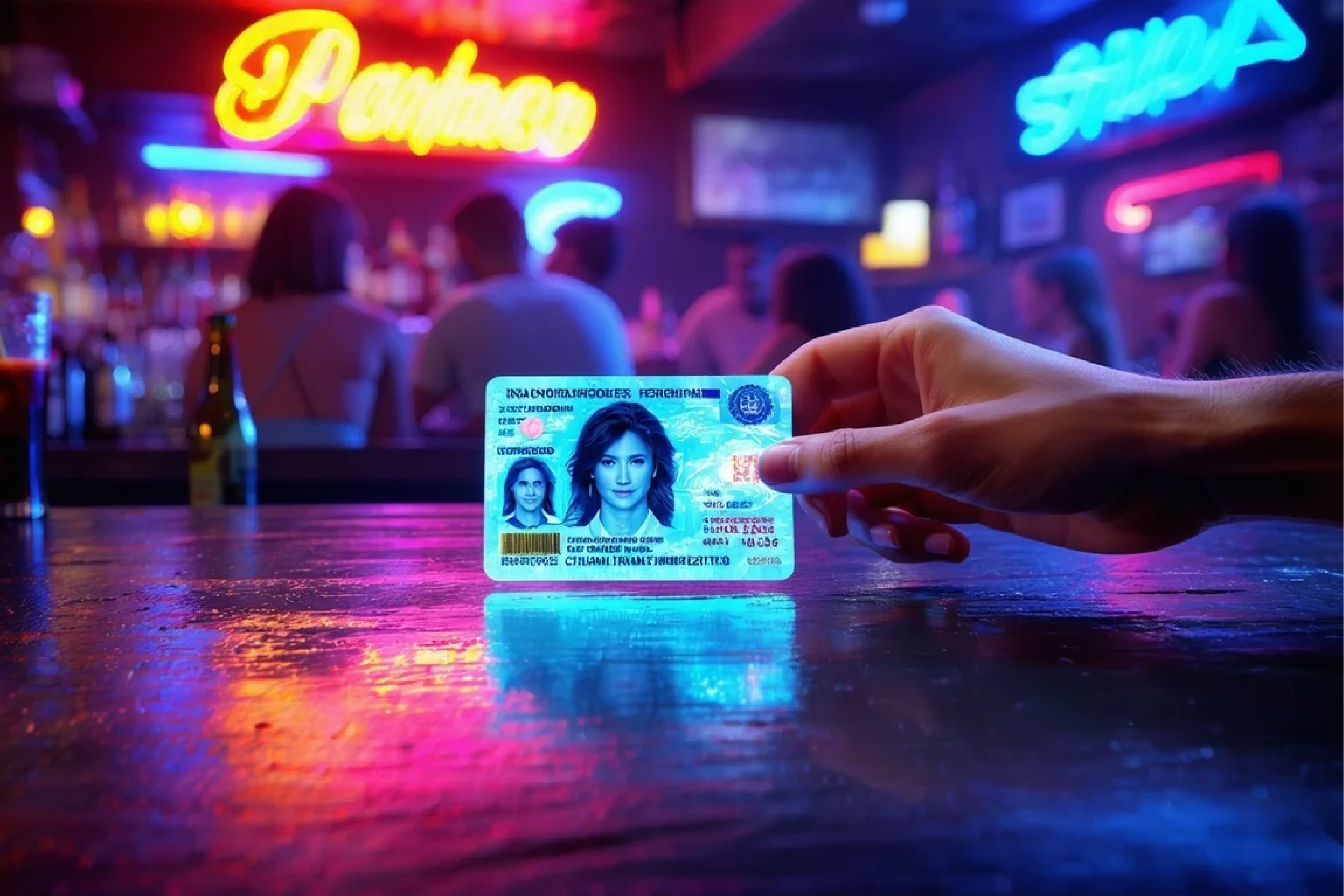
Holograms and UV features can expose some fake IDs, but they aren’t reliable on their own. These features are tested by shining white light on the ID or placing it under ultraviolet light, then checking how it reflects or glows.
Because the tests are so easy to run, counterfeiters prioritize copying these features. Forgers typically either:
- Reproduce holograms and fluorescent overlays as closely as possible, or
- Transfer authentic holograms from real IDs onto fakes.
Whether a fake passes a lighting test depends on two factors: the quality of the fake and the sophistication of the scanner. Patronscan uses custom lighting and hardware sensors to analyze an ID’s reflections. It combines that result with pattern matching, because sophisticated fakes can pass light tests alone.
Why the Scanning Engine Matters Most
The scanning engine is the software that interprets everything a scan captures and decides whether an ID is valid. Even a scanner that runs all three tests will pass fake IDs if its engine is weak.
A reliable scanning engine:
- Is trained on millions of real scans
- Is updated continuously as new ID designs and new fakes appear
- Keeps false positives low, so legitimate customers aren’t turned away
Without one, scanners produce frequent false positives, fail to read newer IDs, and let the latest generation of fakes through.
ID Verification Methods Compared
| Method | What it checks | Catches | Misses |
| Barcode / magstripe scan | Data format on the back of the ID | Low-quality fakes with faulty barcodes | Most fakes sold online today |
| Visual check by staff | Photo, look and feel, obvious errors | Crude fakes | Advanced fakes; depends on training and attention |
| UV / hologram light test | How the ID reflects or fluoresces | Fakes without copied light features | High-end fakes that replicate these features |
| Pattern matching | Imagery, fonts, spacing vs. an authentic template | Advanced fakes with pixel-level differences | Little, if the template library is current |
| Multi-test scanner with a strong engine | All of the above, weighed together | The widest range of fakes | New ID designs if the library isn’t updated |
Forensic ID Scanning: How Patronscan Stops Fake IDs
Basic ID scanners only read the barcode, but Patronscan analyzes the whole ID, which is why it catches up to 90% of fake IDs, including fakes that pass a barcode-only check.
Why Patronscan catches what other scanners miss
- 8,500+ forensic checks per scan: Every ID is analyzed against thousands of data points, including fonts, spacing, layout, and imagery, to catch high-quality fakes.
- Multi-light analysis: Infrared, UV and white light reveal security features that are invisible to the naked eye and hard for forgers to copy.
- 14,000+ ID and document types: Driver’s licenses, passports, and government IDs worldwide.
- Weekly template updates: Patronscan’s engineers update the template library every week with new ID designs, security feature changes, and newly identified fake ID patterns.
- The Patronscan Flag Network: Every scan is checked against a shared network of flagged individuals, so someone banned at one venue can be flagged at another.
So, will a fake ID scan?
- With most ID scanners: often, yes. A well-encoded barcode is all a fake needs to pass.
- With Patronscan: unlikely. Patronscan catches up to 90% of fake IDs, because fakes still have to get past 8,500+ forensic checks, multi-light analysis, and a template library updated every week.
Stop fake IDs at your door. Book a free Patronscan demo and see forensic ID scanning in action on real document samples.